Modern vehicles are packed with safety features, but some of these helpful tools might be giving away more than just your tyre pressure. Recent research from IMDEA Networks Institute and its partners have revealed that the Tire Pressure Monitoring Systems (TPMS) found in millions of cars, including popular brands like Toyota, Mercedes, Renault, and Hyundai, can be used to track drivers without their knowledge.
These systems, as we know them, are designed to keep us safe by alerting us when a tyre is low. However, the way they talk to your car’s computer is surprisingly insecure.
Digging Deeper
The research team, which included experts such as Domenico Giustiniano, Yago Lizarribar, and Alessio Scalingi, found that most cars use a direct system. This means a tiny, battery-powered sensor is placed inside each wheel to broadcast radio signals. These messages contain a unique ID number for each tyre that rarely changes.
Because these signals are unencrypted (sent in plain text), anyone with a basic receiver can listen in. Further probing revealed that by grouping the four unique tyre IDs that move together, an observer can create a fingerprint for a specific car. Using a mathematical tool called the Jaccard index, the researchers could match these signals to specific vehicles with high accuracy.
A Cheap Way to Spy
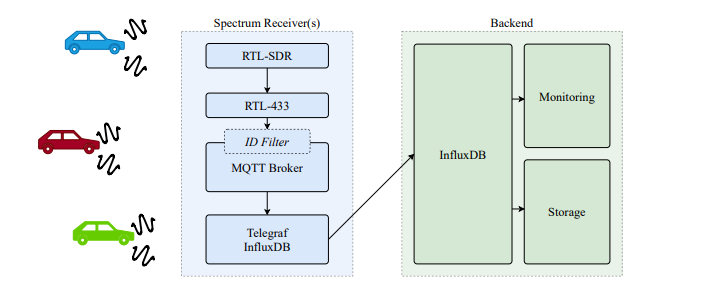
To prove how easy this is, the team set up five low-cost radio receivers along roads for ten weeks. Using equipment costing only about £80 ($100) per device, they collected over six million messages from more than 20,000 vehicles.
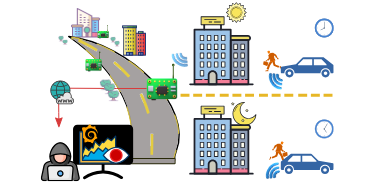
To confirm their findings (PDF), they even included 12 verified cars where they knew the exact tyre IDs beforehand. These signals can be picked up at distances over 50 metres, often through walls and without a direct line of sight. This makes it incredibly easy for someone to hide a receiver inside a building or roadside infrastructure to monitor traffic.
What Your Tyres Reveal
By tracking these IDs, an observer can map out your private life, including your work Schedules. This involves knowing exactly when you arrive and leave, including remote work days when your car stays put. In addition, it gives away your routine changes, such as identifying lunch breaks, evening classes, or gym visits. Also, the sensors broadcast the actual pressure levels to reveal your vehicle’s weight. Such as, higher pressures can suggest a heavier vehicle or a truck carrying cargo.
“We argue that it is rather easy in practice to link TPMS sensors with a specific person of interest. A TPMS signal receiver can be linked to a camera or, if the person of interest’s home address is known, a targeted recording at the person’s home can reveal their unique TPMS sensor IDs. Once these IDs are known, the movements of that person can be tracked with inexpensive, publicly available software-defined radios,” researchers explained how TPMS can be used to spy on a particular target.
The Regulatory Gap
Unlike a smartphone, you cannot simply turn off your tyre sensors. These systems are legally required in the UK and EU. While UN Regulation No. 155 was created to force carmakers to improve cybersecurity, it currently doesn’t clearly require these tyre signals to be encrypted. Therefore, the researchers are now calling on manufacturers and policymakers to adopt “rotating” IDs that change frequently, preventing your car from becoming a permanent tracking beacon.
Deeba Ahmed
