
While IT teams invest heavily in login security, many don’t apply the same scrutiny to password resets. If the reset path is weaker than the authentication path, it becomes the logical target.
Once an attacker gains a foothold, their next step is resetting credentials tied to more valuable accounts. A poorly protected reset process can allow them to move through a network and assume higher privileges while blending in as a legitimate user.
Understanding the risks behind password resets is crucial, so we look at how attackers use password resets to escalate privileges and identify seven practical ways to close those gaps without slowing your team down.
How attackers escalate privileges through password resets
In many environments, the reset process sits slightly outside the robust controls applied to normal authentication. Rather than trying to break through hardened login defenses, attackers look for reset paths that are easier to manipulate. Common escalation paths include:
Compromised standard accounts: An attacker gains access to a low-privilege user, then explores reset options for higher-value accounts. This is especially dangerous where helpdesk tools or loosely scoped admin rights allow lateral movement.
Helpdesk social engineering: Attackers impersonate employees, claim they’re locked out, and push for urgent resets. Under pressure, inconsistent identity verification can lead to access being handed over.
Reset token interception: If email accounts are compromised, multi-factor authentication (MFA) relies on SMS, or recovery settings are misconfigured, attackers can capture reset links or one-time codes without knowing the original password.
Abuse of over-permissioned admins: Users with broad reset rights can, intentionally or otherwise, change credentials for accounts beyond their role, creating an escalation opportunity.
Secure your Active Directory passwords with Specops Password Policy
Verizon’s Data Breach Investigation Report found stolen credentials are involved in 44.7% of breaches.
Effortlessly secure Active Directory with compliant password policies, blocking 4+ billion compromised passwords, boosting security, and slashing support hassles!
Seven ways to secure password resets
1. Require MFA
MFA is one of the most effective controls against privilege escalation through password resets. Requiring MFA for reset requests should be a baseline safeguard in any reset workflow. However, not all MFA methods offer the same level of protection. MFA solutions like codes sent via email and SMS aren’t infallible.
For high-value or administrative accounts, phishing-resistant MFA (such as FIDO2 or hardware-backed authentication) provides stronger protection against token interception. It reduces the effectiveness of token interception, SIM swapping, and credential phishing.
2. Strengthen device security
Password resets initiated from unmanaged or unknown devices create unnecessary exposure. Compromised endpoints, personal devices, or sessions originating from unusual locations all increase risk.
Where possible, limit reset approvals to trusted, managed devices and apply device posture checks. Block or step up verification for requests coming from new geographies or high-risk IPs. Identity alone isn’t enough. MFA validates the user’s identity, not the security posture of the device.
3. Enforce strong password policies
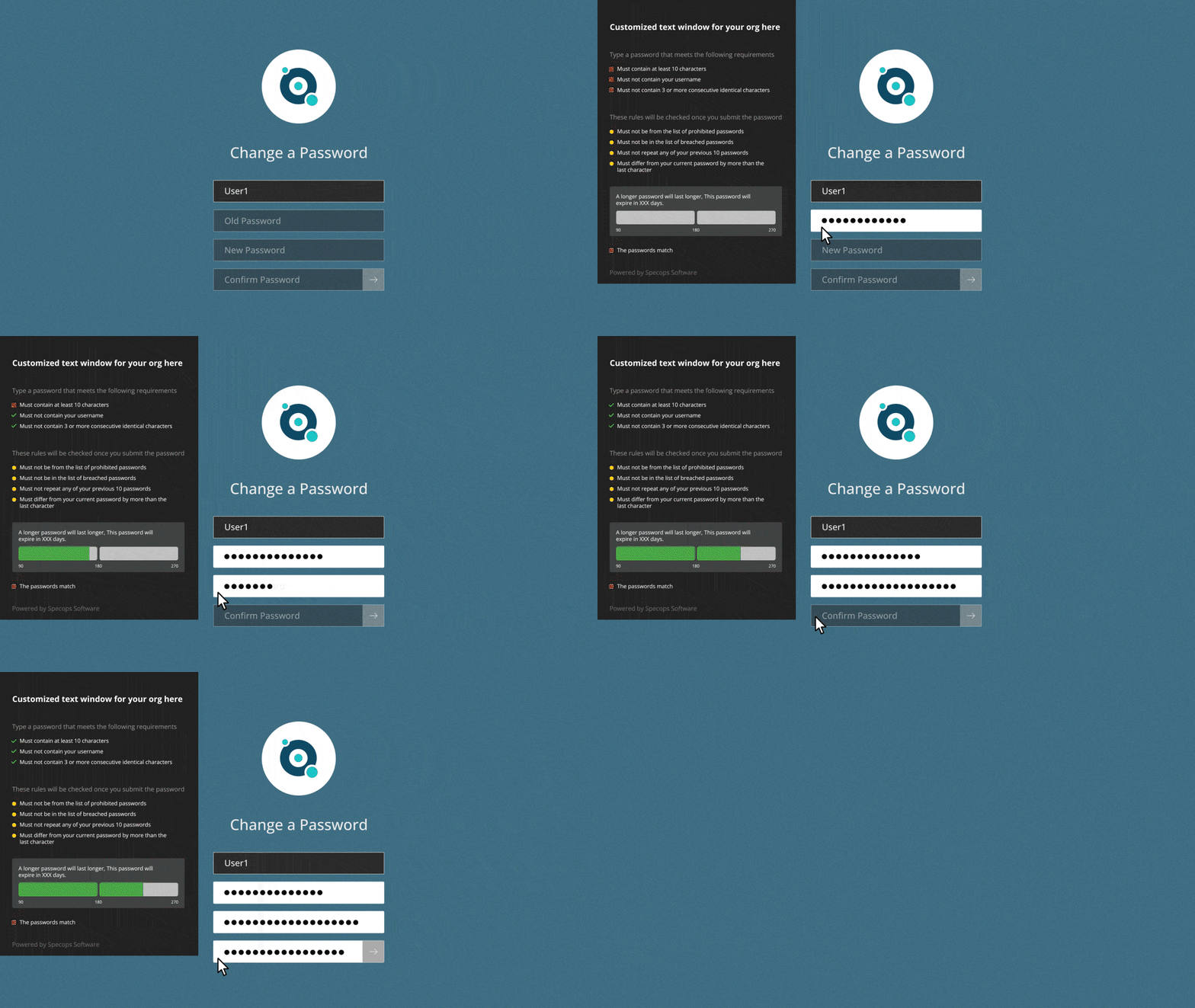
Password resets only improve security if the new password is actually strong. Organizations should enforce clear minimum length requirements, block common or breached passwords, and prevent users from recycling old credentials.
Complexity rules can help, but overly rigid requirements lead to predictable patterns and frustrated users. Passphrases alleviate this issue, as they’re harder to crack and easier for employees to remember.
Solutions like Specops Password Policy help organizations apply stronger, more granular password requirements than those available through Microsoft’s native policies. It also continuously blocks more than 5.4 billion known compromised passwords through the Breached Password Protection feature, reducing the chance of attackers abusing legitimate credentials.
4. Educate users and support teams
Password resets are a frequent phishing target because attackers know urgency lowers caution. Train employees to recognize reset scams, suspicious MFA prompts, and unexpected recovery emails.
Helpdesk teams also need consistent identity verification procedures. Even in environments with self-service resets, a rushed approval can quickly become a privilege escalation path.
5. Run regular audits and monitor reset activity
Organizations should log and review reset requests, especially privileged accounts. Teams should monitor and have alerts for unusual patterns such as repeated attempts, out-of-hours activity, or resets coming from unexpected locations.
It’s also important to regularly audit who has permission to reset passwords for others. Overly broad access can create escalation opportunities that go unnoticed until exploited.
6. Implement least privilege
Applying least privilege helps limit escalation by ensuring users, including administrators, only have the permissions required for their role. That includes restricting who can reset passwords for others and separating high-privilege accounts from everyday user activity.
Privileged access should be tightly scoped, time-bound where possible, and regularly reviewed. The fewer opportunities attackers have to jump from one account to another, the harder it is for one reset to escalate into full administrative control.
7. Avoid knowledge-based authentication
Security questions and other “something you know” checks are no longer a reliable way to protect password resets. Answers are easier to guess as people share more information about themselves on social media. Use possession-based verification instead, such as secure MFA prompts or checks tied to trusted devices.
It’s here that Specops’ zero trust access solution Infinipoint helps by binding user identities to trusted devices, ensuring that authentication only succeeds from approved, enrolled devices.
How Specops can help
Securing password resets means protecting the full account lifecycle, from recovery through to ongoing monitoring. We help organizations reduce privilege escalation risk by strengthening reset workflows through Specops uReset.
Remote users can change their password from any location and at any time of day, whether on or off VPN. Multiple authentication options guarantee users can complete resets even if one identity provider is unavailable.

Our identity security products are designed to support IT teams with the expertise needed to keep access secure without adding unnecessary friction.
If you’d like to see how Specops can help secure your password resets, contact us today or book a demo to see our solutions in action.
Sponsored and written by Specops Software.